Gasherbrum I
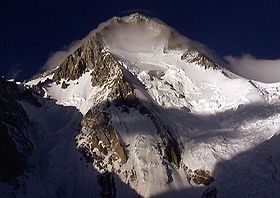
Gasherbrum I (Urdu: گاشر برم -1; simplified Chinese: traditional Chinese: pinyin: Jiāshūěrbùlǔmù I Fēng), also known as Hidden Peak or K5, is the 11th highest peak on Earth, located on the Pakistani–Chinese border in Gilgit–Baltistan region of Pakistan and Xinjiang region of China. Gasherbrum I is part of the Gasherbrum massif, located in the Karakoram region of the Himalaya. Gasherbrum is often claimed to mean "Shining Wall", presumably a reference to the highly visible face of the neighboring peak Gasherbrum IV; but in fact it comes from "rgasha" (beautiful) + "brum" (mountain) in Balti, hence it actually means "beautiful mountain."
Gasherbrum I was designated K5 (meaning the 5th peak of the Karakoram) by T.G. Montgomerie in 1856 when he first spotted the peaks of the Karakoram from more than 200 km away during the Great Trigonometric Survey of India. In 1892, William Martin Conway provided the alternate name, Hidden Peak, in reference to its extreme remoteness.
Gasherbrum I was first climbed on July 5, 1958 by Pete Schoening and Andy Kauffman of an eight-man American
expedition led by Nicholas B. Clinch. Richard K. Irvin, Tom Nevison,
Tom McCormack, Bob Swift and Gil Roberts were also members of the team.
Timeline
- 1934 - A large international expedition, organized by the Swiss G.O. Dyhrenfurth, explores Gasherbrum I and II. Two climbers get to 6,300 m (20,670 ft).
- 1936 - A French expedition gets to 6,900 m (22,640 ft).
- 1958 - An American team makes the first ascent.
- 1975 - Reinhold Messner and Peter Habeler reach the summit on a new route (northwest route) in pure alpine style
(first time on an 8000 metre peak) taking 3 days total. One day later,
three Austrians from a different expedition led by Hanns Schell reach
the summit on the American route.
- 1977 - The fourth successful ascent by two Slovenians (Nejc Zaplotnik and Andrej Stremfelj), again on a new route.
- 1980 - A French expedition is successful with the 5th ascent and pass the south ridge for the first time.
- 1981 - Japanese have the 6th successful ascent.
- 1982 - G. Sturm, M. Dacher and S. Hupfauer of a German expedition
summit via a new route on the north face. In the same year, French
Marie-José Valençot is the first woman who reaches the summit. Her
husband, Sylvain Saudan from Switzerland performs the first ski descent from the top of an 8000 metre peak to base camp.
- 1983 - Jerzy Kukuczka with Wojciech Kurtyka, new route. Alpine style ascent without the aid of oxygen.
- 1983 - Teams from Switzerland and Spain are successful.
- 1984 - Reinhold Messner and Hans Kammerlander traverse Gasherbrum II and Gasherbrum I without returning to base camp in between
- 1985 - Solo ascent by Benoît Chamoux. On July 14, the Italian Giampiero Di Federico (solo ascent) opens a new route on the north-west face.
- 2003 - 19 people reach the summit, 4 deaths, including Mohammad Oraz.
- 2012 - March 9, Adam Bielecki and Janusz Gołąb made the first winter ascent. The ascent was made without the aid of supplementary oxygen.
The same day, three climbers from a different expedition; Austrian
Gerfried Goschl, Swiss Cedric Hahlen and Pakistani mountaineer Nisar
Hussain Sadpara, went missing, never to be found again. They were trying
to ascend via a new route and are considered to have been blown off by
strong winds.
Mount McKinley
Alaska, USA
Athabasca Indians tribes call it Denali, meaning the Great in their
language. And mount up to its reputation … McKinley is not only the
highest mountain in North America, but also a great collector of lives.
Among its records include the fact that the king of the mountains of
Alaska is bigger even than Everest. Since it is located in northern high
latitude to make the atmosphere here to be more rarefied than a 8,000
meter high mountain located hypothetically, somewhere near the equator.
Another bold enemy who dare to conquer it, is ubiquitous frost. Here
temperatures are terrible. Winter drops to -60 degrees Celsius and at
times windy, the temperature felt by the human body is found on Denali
-83 degrees Celsius. Due to high latitudes same risk altitude sickness
is very common. For the reasons listed above, mountain climbing success
rate reaches only 50% of trials. Many were those who lost the battle:
every year, dozens of climbers lose their lives on icy slopes. 2003 was
the worst – 100 climbers have died to meet the Great.
Its height is 6194 M:

Mount Fuji, Japan

Mountains should not be treated in play. Despite their beauty, mountains
hide deadly dangers even for the best climbers. Even our Carpathians,
not giddy heights can be dangerous and deadly traps for those who scorn
the mysteries of Iron Mountain and nescotesc rules of incursions into
the kingdom of stone and wood. So dozens of dead standing testimony
tribute mountains are sacrificed every year. Especially dangerous are
found to be the highest and most inaccessible mountains of the planet.
These stone giants take their mysterious lives even among the best
climbers and mountaineers in the world. If I ever get iron with boot and
his climbing rope, be aware not only of grand spectacle that occurs
every step, but also the dangers that lurk after every crack of stone
and piece of ice.
Its height is about 3776 M.Its looks so beautiful but very dangerous to climb. Unparalleled mountain, how would the Japanese Talmaci, firm reigns above
the capital Tokyo. For millennia, silhouette volcanic cone shaped
perfectly, with top whiteness of the snow dressed in ancient lit the
imagination of poets, painters and lovers of beauty of the Rising Sun
Country. The whole appearance of old mountain, quiet and elevated, Fuji
is relentlessly with tourists. Japanese or foreign, the sacred mountain
of Japan not forgive at all. Every year, in the period between October
and April, dozens of tourists who ignore warnings unconscious
authorities die in cliff collapse.
The cause of death is eminently silly. Mount Fuji is famous for the
sunrise, which, seen from the heights of his shows beautiful pictures,
unique. To get the best possible angle for viewing or photographing,
Japanese tourists climb the mountain at night in hopes of finding the
best places for sunrise. Like climbing a mountain at night is a reckless
act for the uninitiated, many great pictures amateurs find their
Prapastiile passed away in the most beautiful mountain in Japan.
Nanga Parbat, Pakistan
If Urdu (spoken in Pakistan), Nanga Parbat translates into Mount Blank,
because its huge barren rocky heights, well, in the jargon of climbers,
hill macabre reputation has earned the “killer people”. Nanga Parbat
“offer” in full all the ways a tragic end to his kingdom. Here death
lurks around every corner as hade forms and varied: cardiac or pulmonary
edema, fatal frostbite, hypothermia, avalanches, physical exhaustion,
altitude sickness.
A German expedition in 1930 paid the death of 31 members courage to face
Mount Gol. To date, of the 261 climbers who have climbed the tip, 61
have died in the conditions listed above. In 2005, Slovenian climber
Tomaz Humar famous, remained isolated for 6 days on an ice wall at a
height of 5900 meters, has escaped with his life only because of the
intervention lucky Pakistani army, which rescued by a helicopter. Among
the latest victims of Italian mountain climber include Karl
Unterkircher, which in 2008 fell into a crevasse. A year ago, South
Korean climber Go Mi-Sun slid into a ravine due to high winds, when they
came down from the mountain after a succesful ascent …
Its height is about 8128 M.its the most dangerous mountain in the world.Many people lost their life by climbing this mountain.

K2
The Associated Press (AP) and CNN reported about midday UTC that the death toll in the Sunday's accident on K2 has risen to eleven.
Two Dutch climbers have been rescued by helicopter, the AP also said.
CNN reports that two of the people killed were climbing up the mountain
in an attempt to assist others.
AP says that about two dozen climbers began the accent of K2, the
world's second-highest mountain, Friday after the weather had cleared.
Climbers are listed as from the Netherlands, South Korea, Italy, Norway, France, Nepal, Serbia, Pakistan and Ireland.
Trouble began on Sunday when several climbers decided to turn back
citing rope placement problems. CNN reports the group was climbing in
two teams and both were descending from near the summit when an a large
chuck of ice fell sweeping three people off the mountain.
The ice triggered an avalanche which caused confusion within the party.
Wilco Van Rooijen, one of the two rescued Dutch climbers, spoke to AP
via phone. He blames poor planning in addition to the avalanche.
"Everything was going well to Camp Four, and on summit attempt, everything went wrong," Van Rooijen said.
He told AP that a low-cloud bank caused whiteout on the mountain, but
he chose to begin his decent from the area near the summit.
"There was a Korean guy hanging upside down," Van Rooijen told AP.
"There was a second Korean guy who held him with a rope but he was also
in shock and then a third guy was there also, and they were trying to
survive but I had also to survive."
One stranded climber, Marco Confortola, an Italian who spoke with his brother by phone, described the events as hellish.
"Up there it was hell. During the descent, beyond 8,000 meters
(26,000 feet), due to the altitude and the exhaustion I even fell asleep
in the snow and when I woke up I could not figure out where I was,"
Confortola told the ANSA news agency.
A helicopter rescue for Confortola had to be delayed due to poor
weather. He told his brother that he was able to walk down to the base
camp.
CNN reports that this is the deadliest accident on K2 since records
were kept in 1939. 66 people — not counting those in the latest incident
— have died on the mountain since then.
Malika Parbat
Malika Parbat (Queen of the mountains) (el. 5,290 metres (17,356 ft) is the highest peak in Kaghan Valley, Khyber Pakhtunkhwa, Pakistan about six km south of Lake Saiful Muluk near Ansoo Lake.
The mountain is clearly visible from the popular tourist spot of Lake
Saiful Maluk in Kaghan Valley. Malika Parbat is accessible from
Naran-Lake Saiful Muluk side and from Batakundi-Dadar Chitta Glacier.
There are three summits that forms Malika Parbat, Malika Parbat (North
Peak), Malika Parbat Cresta, and Malika Parbat (South Peak).
 The mountain is clearly visible from the popular tourist spot of Lake
Saiful Maluk in Kaghan Valley. Malika Parbat is accessible from
Naran-Lake Saiful Muluk side and from Batakundi-Dadar Chitta Glacier.
There are three summits that forms Malika Parbat, Malika Parbat (North
Peak), Malika Parbat Cresta, and Malika Parbat (South Peak).
Imran Junaidi from Pakistan and Jens Simonsen from Denmark climbed
the Malika Parbat (North) peak in July, 2012. Imran Junaidi is the first
Pakistani to have climbed the North peak. The mountain is considered
non-climbable among the local population due to steepness and other
mountain hazards.
Recently, an expedition of four members led by Ahmed Mujtaba Ali
(Pakistan) and including of reported to Summit the Malika Parbat in the
month of August 2012.Other members of the expedition were Ahmed Naveed, Kammal Haider, and
Saqib Ali. Rashid Butt lost his life while descending down the sheer
slopes on South Peak.
This is for the very first time that a couple of expeditions
attempted the peak and succeeded in reaching the sky. Malika Parbat is
considered to be the most technical peak above 5,000 metres.
There are other peaks which offer considerable climbing difficulty in
Siran Basin, Khabanar Valley and Burji Valley, while from Burawai,
another cirqua of low peaks is equally good for mountaineering.
The mountain is clearly visible from the popular tourist spot of Lake
Saiful Maluk in Kaghan Valley. Malika Parbat is accessible from
Naran-Lake Saiful Muluk side and from Batakundi-Dadar Chitta Glacier.
There are three summits that forms Malika Parbat, Malika Parbat (North
Peak), Malika Parbat Cresta, and Malika Parbat (South Peak).
Imran Junaidi from Pakistan and Jens Simonsen from Denmark climbed
the Malika Parbat (North) peak in July, 2012. Imran Junaidi is the first
Pakistani to have climbed the North peak. The mountain is considered
non-climbable among the local population due to steepness and other
mountain hazards.
Recently, an expedition of four members led by Ahmed Mujtaba Ali
(Pakistan) and including of reported to Summit the Malika Parbat in the
month of August 2012.Other members of the expedition were Ahmed Naveed, Kammal Haider, and
Saqib Ali. Rashid Butt lost his life while descending down the sheer
slopes on South Peak.
This is for the very first time that a couple of expeditions
attempted the peak and succeeded in reaching the sky. Malika Parbat is
considered to be the most technical peak above 5,000 metres.
There are other peaks which offer considerable climbing difficulty in
Siran Basin, Khabanar Valley and Burji Valley, while from Burawai,
another cirqua of low peaks is equally good for mountaineering.

